Last updated October 15, 2026
ADU Permits, Codes & Inspections in CA: What You Need to Know
California’s 2020 ADU law reform was supposed to simplify permitting statewide, and it did in some ways, but Ventura homeowners still navigate a two-jurisdiction reality where city rules, county health, and the California Building Code interact in ways that stall projects for months if you don’t know the sequence. State law now prohibits most cities from requiring owner-occupancy or excessive setbacks for ADUs, but it does not stop local agencies from enforcing their own utility connection fees, which in Ventura can add $15,000 – $40,000 to a project budget that was calculated using only state-level guidance. This guide explains what the state law actually changed and what it didn’t, so you can build an ADU in Ventura without getting blindsided by the permit counter.
Quick Answer
Most ADUs in Ventura are approved through a ministerial (by-right) process, meaning the city must approve your permit if your plans meet state and local code within 60 days of submittal. A detached ADU up to 1,200 sq ft can be built on any residentially zoned lot in Ventura, and California law caps most impact fees for ADUs under 750 sq ft. Expect the full permit sequence (Planning, Building & Safety, Fire, and Water & Sanitation) to take 3 – 6 months in Ventura, with inspections adding another 4 – 8 months of build time depending on whether you go site-built or prefab.
Table of Contents
- What California’s ADU Law Actually Changed (and What It Didn’t)
- The Ventura Permit Sequence: What Runs Concurrent and What Must Wait
- Ministerial vs. Discretionary Approval: Which Ventura Projects Get Slowed Down
- Impact Fees: What the State Limits and What Ventura Still Charges
- ADU Inspection Stages: What Inspectors Check at Each Visit
- What Causes a Failed Inspection in Ventura Specifically
- Prefab and Modular ADUs: How Boxabl, Plant Prefab, and Mighty Buildings Permits Differ
- Common Mistakes to Avoid
- When to Call a Professional
- Frequently Asked Questions
What California’s ADU Law Actually Changed (and What It Didn’t)
California’s ADU statutes changed dramatically between 2020 and 2023, with AB 2221 and SB 897 doing the heavy lifting. Here’s what those laws actually did for a homeowner in Ventura, and what they left alone.
What changed statewide:
- Owner-occupancy is largely dead. Cities cannot require you to live in either the ADU or the main house for projects permitted before January 1, 2025. Ventura cannot impose an owner-occupancy condition on a new detached ADU.
- Setbacks are now codified. A detached ADU can be built with a 4-foot side and rear setback by state law. A conversion of an existing space (garage, basement, storage) requires no additional setback. A two-story ADU within 4 feet of the property line must still meet fire-resistance requirements for the wall facing that line.
- Height limits went up. A detached ADU can reach 16 feet by default, 18 feet if it’s attached to or within a half mile of a transit stop or major transit corridor, and up to 25 feet if it sits over a garage. Ventura’s coastal zone overlays can modify those heights in specific neighborhoods, including the Midtown corridor and portions of the Avenue.
- Parking requirements were eliminated for most ADUs within a half mile of a transit stop, in historic districts, or when the ADU is a conversion of existing space. Even where parking can be required, Ventura must allow tandem parking on a driveway.
- Approval timelines are now mandatory. Ventura must issue a decision on a complete ADU permit application within 60 days. If they don’t, the application is deemed approved. That does not mean the permit is issued automatically: the city can still require corrections, but a new review cycle is limited to 60 days each time.
What stayed local:
- Utility connection fees. The city’s Water & Sanitation department sets its own meter installation, connection, and capacity fees. Ventura water and sewer connection charges typically run $15,000 – $40,000 depending on whether the ADU shares the existing water line or requires a new one, and whether the sewer lateral must be upsized. State law caps some impact fees for ADUs under 750 sq ft, but connection fees are not entirely off the table, and Ventura’s fee schedule reflects actual utility cost recovery, not a penalty.
- Architectural and materials review. The state requires that Ventura apply the same design standards to ADUs that it applies to primary residences, but Ventura still reviews your ADU for consistency with neighborhood character requirements in historic districts. A Tuff Shed shell converted in the Downtown Historic District will go through a different level of review than one in East Ventura.
- Fire access and defensible space. Ventura County’s fire code is stricter than state baseline for properties in wildfire hazard zones. If your lot is in the hills above Foothill Road or in the canyons off the 33, expect Fire Department review of access drive widths, turnaround radii, and brush clearance. That review is outside the state ADU law’s reach.
We’ve seen homeowners build a full budget in Excel using state guidance only, then walk into Ventura’s permit office and learn their Water & Sanitation fees alone match the cost of a modest foundation. The state law gave you the right to build; it didn’t give you the right to skip the local meter. That distinction is the single most important thing to understand before you draw a line on a plot plan.
Those just beginning their research often start at the Sutton ADU Ventura home page, which walks through the basic ADU types permitted under Ventura’s current zoning.
The Ventura Permit Sequence: What Runs Concurrent and What Must Wait
Ventura’s permit process is not a single chain. It’s four agencies that each review a portion of your plan, and understanding which reviews run in parallel versus which must happen in order is how you take months off a timeline.
Here is the typical sequence, in order, for a detached ADU on a standard residential lot in Ventura:
- Planning Division review (2 – 4 weeks). This is where your plot plan, setbacks, height, lot coverage, and location of utilities get checked against zoning. For a by-right ADU, this is a checklist review, not a design critique. Planning verifies your ADU is not in a flood zone, not in a coastal overlay that changes height limits, and not inside a historic district that triggers additional architectural review.
- Building & Safety plan check (4 – 8 weeks). Your structural drawings, Title 24 energy reports, and fire-rated assemblies are reviewed here. This stage is where most plan corrections happen in Ventura. If your draftsperson hasn’t worked in the city before, expect two rounds of corrections, which adds 6 – 8 weeks total. A local draftsperson who knows Ventura’s typical comments can often get through in one round.
- Fire Department review (runs concurrent with Building & Safety). Ventura Fire checks access, fire-rated walls on the setback side, and whether your ADU triggers any sprinkler requirement. If your ADU is within 4 feet of the property line on the setback side, the wall facing that line must be one-hour fire-rated. The Fire review runs alongside Building & Safety and does not add time unless corrections are requested.
- Water & Sanitation review (starts after Building & Safety clears). This is the sequential gate. You cannot get a water meter approval until your plumbing plans are approved by Building & Safety. Water & Sanitation then determines whether your existing 1-inch or 3/4-inch meter has sufficient capacity for the ADU. Many older Ventura homes have 3/4-inch meters that must be upsized, which triggers a meter upgrade fee plus trenching from the main.
- Permit issuance (1 – 2 weeks after all four divisions clear). This is where you pay plan check fees and the permit is stamped. Building & Safety cannot issue the permit until Water & Sanitation signs off, which cannot happen until Fire signs off, which usually depends on Building & Safety’s structural approval. The chain matters.
In our experience, the fastest a site-built ADU has moved through Ventura’s full permit sequence is about 9 weeks from submittal to permit, assuming a complete application and one round of corrections. The slowest we’ve seen is 9 months, almost always because of a sewer lateral that required a separate encroachment permit to work in the street. If your sewer lateral runs under a public sidewalk and needs upsizing, budget 6 – 10 extra weeks for that encroachment permit alone.
A note: Ventura moved to electronic plan submittal in 2021, and corrections are handled through the portal. That’s an improvement over the old paper process, but it also means every resubmittal re-enters the queue at the back. A common error is uploading corrected sheets without a point-by-point response to the plan checker’s comments. Put the responses in a single PDF. The plan checker in Ventura appreciates it, and it saves you a third cycle.
For homeowners weighing a detached ADU against a simpler addition, the process differs enough that we point readers to our Home Addition Contractor in Ventura page to compare.
Ministerial vs. Discretionary Approval: Which Ventura Projects Get Slowed Down
California law splits ADU approvals into two buckets: ministerial (the city must approve if your plans meet code) and discretionary (the city has latitude to condition or deny the project). The distinction determines whether your ADU gets a 60-day decision or a hearing with public notice, and it’s the least-understood part of the process.
Ministerial approval (by-right) applies to:
- Any detached ADU up to 1,200 sq ft on a lot with an existing single-family home.
- Any conversion of existing space (garage, storage, attic) into an ADU, any size up to 1,200 sq ft.
- Any attached ADU up to 50% of the primary home’s square footage and no more than 1,200 sq ft.
- Two ADUs on one lot: one detached and one attached or converted, subject to lot size.
If your project falls in one of those categories, Ventura’s Planning Division is required by law to use a checklist, not judgment. No public hearing, no neighborhood notification, no design board. The 60-day clock starts when the city deems your application complete.
Discretionary review still applies to:
- ADUs in the Coastal Zone. Portions of Ventura west of the 101 and south of Main Street fall under the California Coastal Act, which is a whole different regulatory layer. A Coastal Development Permit may be required, and that is discretionary. The Commission has authority over these permits, not just the city. If your lot is within the coastal zone, the 60-day clock effectively doesn’t protect you.
- ADUs that exceed the new 1,200 sq ft cap and require a lot coverage variance. Above the cap, you’re outside the ADU law and back in standard discretionary zoning.
- ADUs in the Downtown Specific Plan area. Ventura’s Downtown has design standards that function as a discretionary overlay, and although the state law limits how much those standards can constrain an ADU, they still trigger additional review time.
- Lots with unpermitted existing work. If the city has a record of unpermitted construction on the property, the ADU permit can be held until that work is either legalized or removed. This is more common in older East Ventura neighborhoods than people expect.
We tell homeowners this before they buy a lot or sketch a plan: ask the Planning Division, in writing, whether your specific parcel is in the coastal zone or a historic overlay. Do not rely on a real estate listing or a neighbor’s assurance. The answer changes whether you’re building on a by-right timeline or a discretionary one, and the difference can be six months.
Those considering a custom ADU build in Ventura benefit from checking parcel-level constraints before they commit to a prefab product line that may require design review the city won’t waive.
Impact Fees: What the State Limits and What Ventura Still Charges
This is where the savings from California’s ADU law show up on paper, and where a Ventura budget can still go sideways.
State law (specifically AB 68, SB 13, and AB 2221) restricts cities from charging impact fees on ADUs that meet certain size and type thresholds. The rules as they apply today:
- ADUs under 750 sq ft: Ventura cannot charge impact fees (parking fees, traffic mitigation fees, school fees, park fees) for the ADU itself. The city can only charge fees proportional to the ratio of ADU square footage to the primary home. For an 800 sq ft ADU on a lot with a 1,600 sq ft home, the city can charge impact fees on 50% of what it would charge for a single-family home. For a 750 sq ft ADU or smaller, the impact fee bill is effectively zero in Ventura.
- ADUs 750 – 1,200 sq ft: Proportional fees apply as above, but Ventura can and does impose them. School fees in Ventura Unified run roughly $4.00 – $4.50 per square foot of chargeable area, so a 1,000 sq ft ADU on a lot with a 2,000 sq ft main house would owe school fees on 500 sq ft: approximately $2,000 – $2,250.
- Water and sewer connection fees: These are not classified as impact fees under state law, which means Ventura’s Water & Sanitation department can still charge full connection fees regardless of ADU size. This is where the $15,000 – $40,000 range comes from. Specifically: a new water service connection (if the ADU needs its own meter or a larger main meter) plus a sewer lateral connection with upsizing plus a capacity charge for wastewater treatment. The exact total depends on your lot’s existing infrastructure and the ADU’s projected water usage in gallons per day.
- School fees cannot be charged on ADUs under 750 sq ft, period. This was a specific AB 2221 clarification that saved many Ventura homeowners $6,000 – $10,000 compared to pre-2022 fee schedules.
Here’s what we tell clients to do before they ask a builder for a preliminary budget: call Ventura Water’s new-connection desk and ask for a fee estimate for an ADU of your planned size on your specific parcel. The desk will ask for the Assessor’s Parcel Number, and in about a week you’ll get a letter with the exact connection fee schedule. That one letter is worth more than any online calculator.
For a room addition rather than a detached ADU, Ventura treats the fee structure differently because a room addition doesn’t trigger a new utility connection in most cases. The Room Addition Contractor in Ventura page details those differences.
ADU Inspection Stages: What Inspectors Check at Each Visit
Once your permit is issued and construction starts, the city comes out in a fixed sequence. Each inspection is a gate: you cannot proceed past a failed inspection until the correction is made and the inspector returns. Here is what each visit actually covers for a typical detached ADU in Ventura.
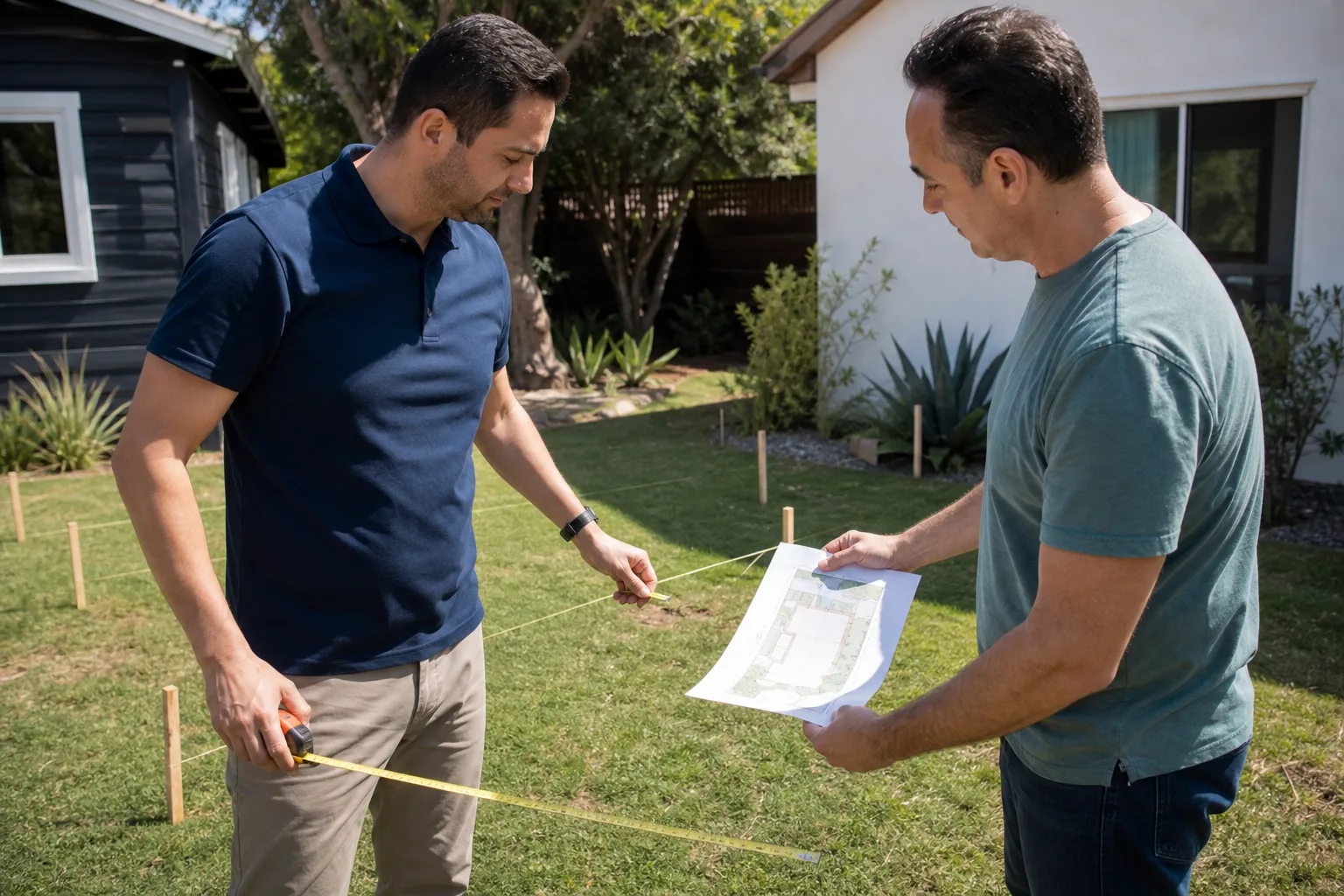
- Foundation / setback inspection. Before concrete is poured, the inspector verifies forms are set at the correct depth, rebar spacing matches the approved structural drawings, and the slab or footings sit the proper distance from property lines. This is the inspection most likely to catch a survey error. Ventura requires a setback verification form from a licensed surveyor on many detached ADUs before this inspection will be scheduled.
- Underground / rough plumbing. After slab or underfloor plumbing is installed but before it’s covered, the inspector checks sewer slope (minimum 1/4 inch per foot in Ventura), pipe size, cleanouts, and the connection point to the existing sewer lateral. The Water & Sanitation inspector is a different person from the Building & Safety inspector, and this is the one inspection where both agencies may be present or scheduled back-to-back.
- Framing inspection. The full skeleton is checked against the approved structural plans: stud size and spacing, shear wall nailing pattern, hold-down placement, header sizing over doors and windows, and fire-rated assemblies on walls within 4 feet of the property line. Ventura inspectors are known to check nail patterns with a gauge, not a glance. Missing one nail per stud in a shear wall has failed more framing inspections than any structural deficiency we’ve seen.
- Rough electrical and mechanical. Wiring is checked for gauge, support, and box fill before drywall goes up. The mechanical inspection covers ductwork or mini-split line sets. If your ADU has a gas line for a tankless water heater, the inspector checks pressure testing documentation. Ventura enforces the current California Electrical Code, which now requires AFCI protection on nearly all 120-volt circuits in an ADU.
- Insulation and drywall nailing. Insulation R-values are checked against Title 24 energy compliance (R-13 walls, R-30 ceiling typical in Ventura’s climate zone). Drywall nailing is checked for spacing before tape and texture. This inspection often gets combined with the next one.
- Final building inspection. The complete structure: finished plumbing fixtures, clearance and operation of the water heater, smoke and carbon monoxide detectors (one in each sleeping room and one on each floor), handrails at stairs, and egress windows in sleeping spaces. The inspector issues the final sign-off only after every other inspection is approved.
For a prefab ADU from Plant Prefab or Boxabl, the inspection sequence compresses because modules arrive with most rough-in work already passed under the manufacturer’s quality-control documentation and state-approved modular plan. Ventura still performs the foundation, utility connection, and final inspections locally, but the framing, electrical, and mechanical rough inspections often get folded into a single factory-certified review. That’s one reason a prefab timing advantage is real, though the local utility and foundation work still takes the same number of site days.
What Causes a Failed Inspection in Ventura Specifically
Failed inspections are ordinary. They are not a sign your builder is incompetent; they are a sign the code is detailed. That said, knowing the most common failure points in Ventura keeps your project on schedule.
- Shear wall nailing not to plan. Ventura’s seismic requirements under the current California Building Code require specific nail spacing on plywood shear walls. The spacing changes from panel edges to field, and when a framing crew uses the same spacing throughout to save time, the inspector catches it. The correction often means removing and re-nailing entire wall sections, which can cost $4,000 – $8,000 in labor and schedule time.
- Setback verification missing at foundation stage. Many builders pour footings before the surveyor’s setback verification is on file with Building & Safety. In Ventura, that document must be submitted before the foundation inspection will pass. If the surveyor shows 3 feet 11 inches to the line where 4 feet was required, the whole pad is nonconforming.
- Fire-rated wall assemblies not documented. When your ADU sits within 4 feet of a property line, the wall assembly must be one-hour rated. The inspector wants to see the UL assembly number, the manufacturer of the drywall, and the correct screw pattern. A standard 5/8-inch Type X drywall on wood studs is usually enough, but crucially, the rating document must match exactly what’s installed. Using a different drywall brand than the UL listing cites is a fail.
- Sewer lateral slope issues under the new ADU. Ventura’s older neighborhoods, especially around Midtown and the Avenue, have sewer laterals that were never designed for a second dwelling’s flow. When a builder ties the ADU into an existing lateral with insufficient slope, the Water & Sanitation inspector fails the underground inspection. The fix can require a new sewer lateral to the main, which is where the encroachment permit and $15,000 – $25,000 in street work appears.
- Title 24 discrepancy between plans and installed equipment. If your approved plans specify a certain mini-split heat pump SEER rating and the contractor installs a cheaper unit, the final mechanical sign-off fails. Ventura’s inspectors check the model number against the plan’s equipment schedule. This is the most avoidable failure point, and it happens because substitutions get made without a plan revision.
- Missing carbon monoxide detector at final. This sounds small, but it’s the single most common final-inspection fail in Ventura. The code requires a CO detector outside each sleeping area and one on each habitable floor. Contractors install them in the main house but forget the ADU’s sleeping room is now a separate occupancy with the same requirement.
- Foundation and anchorage. The module’s HCD approval covers the box; the foundation that holds it in a seismic event is designed and permitted locally. Ventura reviews the engineered foundation plan, and the foundation inspection is the same as for a site-built ADU.
- Site utilities. Water, sewer, and electrical connections are local permits, and the Water & Sanitation fees are exactly the same whether you drop a Mighty Buildings panel unit or pour walls on site.
- Site development. Driveway approaches, retaining walls, fire access, and drainage are all Ventura permits. A prefab ADU doesn’t bypass the lot-level work; it changes when the majority of inspections happen.
- Calculating a budget without the Water & Sanitation fee letter. The single most expensive surprise in Ventura is the utility connection charge. Get the fee estimate in writing from Water & Sanitation before you commit to a floor plan. A $15,000 difference changes whether you build a 800 sq ft ADU or a 600 sq ft one.
- Buying a prefab unit before checking the parcel’s code overlays. A coastal zone or historic district determination changes what the city will approve on the exterior. Buy the unit after the Planning Division confirms your parcel is by-right and not subject to architectural review, not before.
- Ignoring the sewer lateral until the under-slab inspection. If your lateral needs upsizing, that’s an encroachment permit into the public right-of-way. Discovering it at the underground plumbing inspection means weeks of delay while the permit processes. A plumber can camera the lateral before construction starts for under $300, and that’s among the best money you’ll spend on the project.
- Assuming the 60-day rule means your permit is ready in 60 days. The clock starts when the application is deemed complete, not when you submit it. In Ventura, a first submittal that triggers a completeness review list then a corrections cycle can spend 90 – 120 days in process even though no individual review exceeded 60 days.
- Using a draftsperson without Ventura plan-check experience. The same set of plans that passes in Oxnard or Camarillo may bounce in Ventura over fire-rated wall details or Title 24 equipment schedules. A local draftsperson knows the city’s typical comments and designs around them from sheet one.
- Forgetting the CO detector. It’s small, it’s cheap, and it’s the most common final-inspection fail. Install one outside the ADU’s sleeping area and one on the main floor before the final visit.
In our experience, about one in three Ventura ADU inspections fails on the first visit for something listed above. The difference between a one-week delay and a two-month delay is whether the correction requires resubmitting plans or opening a wall. A builder who works regularly in Ventura knows these failure points before the trip, not after.
Prefab and Modular ADUs: How Boxabl, Plant Prefab, and Mighty Buildings Permits Differ
Adding a prefab or modular ADU changes the permit path in ways that matter for your timeline and your budget.
Factory-built modular units from companies like Plant Prefab, Boxabl, and Mighty Buildings are permitted under a different section of the California Building Code: the state’s factory-built housing program. The modules themselves are approved by the California Department of Housing and Community Development (HCD) or an approved third-party agency, and that approval is valid statewide. Ventura cannot reject a prefab module because it doesn’t like the manufacturer’s wall assembly; the state approval preempts local code review of the module itself.
What Ventura still reviews locally:
The practical effect: a Plant Prefab or Boxabl ADU can shave 3 – 6 months off the build schedule compared to site-built in Ventura because module fabrication and site foundation work run concurrently. But the permit sequence up front is not faster. You still need Planning, Building & Safety plan check of the foundation and site work, Fire, and Water & Sanitation. The 60-day rule still applies, and the same corrections cycles happen. A prefab manufacturer’s standard foundation package speeds the plan check, but the city’s review is not waived.
One Ventura-specific caution: if your lot is in a historic district, the city’s architectural review applies to the module exterior, not the structure inside. A Boxabl unit with its standard gray and white exterior may not pass architectural review in the Downtown Historic District without a cladding modification. That modification is possible but adds cost and review time. A Tuff Shed conversion similarly faces architectural review if the shed’s roofline or cladding falls outside district guidelines. We check the parcel’s overlay status before we ever recommend a specific prefab product.
For Ventura homeowners still deciding between ADU builders in Ventura versus owner-managed construction, understanding the permit sequence is the first step toward an informed choice.
Common Mistakes to Avoid
When to Call a Professional
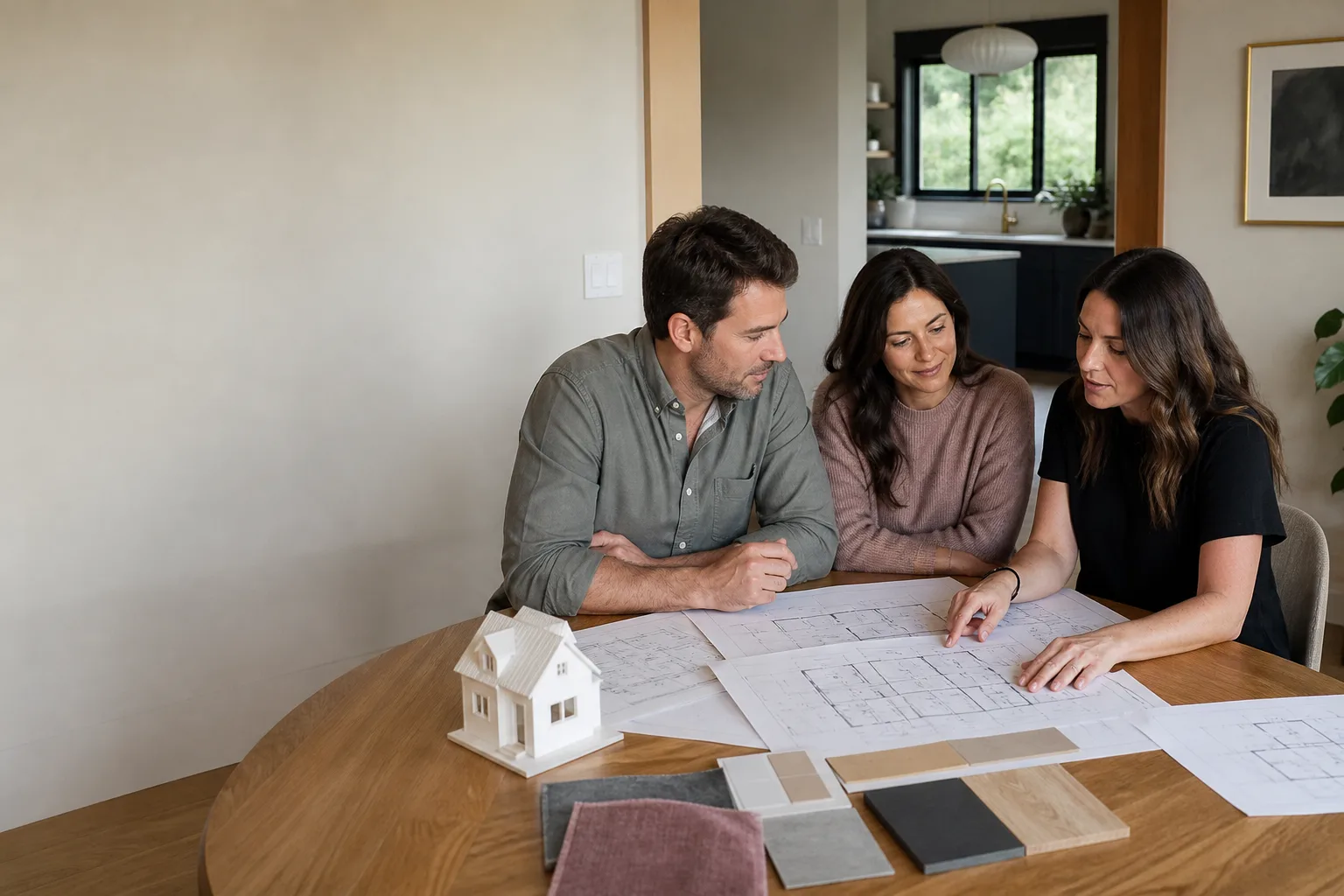
Some homeowners manage their own permits and hire subs directly. That’s a legitimate path, and the city doesn’t discriminate. But certain situations in Ventura warrant a professional from the first phone call. If your parcel is in the coastal zone, a historic district, or a hillside fire zone, the regulatory overlap gets complex quickly: you’re answering to the Coastal Commission or the Fire Department in addition to the city, and the order of approvals matters. If your sewer lateral needs upsizing under a public street, the encroachment permit and traffic control plan are contractor-level work. If you’ve never read a structural plan set and don’t know a shear wall nail schedule from a hold-down detail, hiring a builder who works in Ventura weekly is the difference between a 6-month project and a 16-month one. Sutton ADU Ventura offers free estimates in Ventura. Call (350) 238-1748 and bring your parcel number; we’ll help you understand which fees and reviews actually apply to your lot before you spend a dollar on plans.
Frequently Asked Questions
Plan check fees for a detached ADU in Ventura typically run $8,000 – $15,000 depending on project value and size, and utility connection fees add another $15,000 – $40,000. The total permit package before construction is usually $25,000 – $55,000. School and impact fees are waived or reduced for ADUs under 750 sq ft under state law. Call (350) 238-1748 for an exact fee estimate for your parcel.
Ventura cannot require fire sprinklers in a detached ADU solely because the main house lacks them. However, portions of the city within wildfire hazard zones may trigger a Fire Department requirement for defensible space and access improvements, and an ADU over a garage may require a one-hour separation assembly that includes a sprinkler if the garage is attached to the main home. Ask the Ventura Fire Department for their specific trigger for your parcel.
A complete application for a by-right ADU in Ventura must be decided within 60 days by state law. In practice, if your first submittal requires completeness review or a round of corrections, expect 3 – 6 months from first submittal to issued permit. Discretionary projects in the coastal zone can take longer.
No. California law prohibits Ventura from requiring owner-occupancy of either the ADU or the main house for projects permitted after January 1, 2020. You can rent out the ADU, the main home, or both. A handful of older Ventura ADUs built under the pre-2020 ordinance still carry owner-occupancy conditions, but new permits do not.
Yes. A conversion of an existing garage or other existing space into an ADU requires no additional setback under California law. The existing structure can sit on the property line, and the city cannot require you to demolish and rebuild it with a larger setback. The walls on the property line side must still meet fire-rating requirements for the conversion.
Yes. The module itself is pre-approved by the state, but the foundation, site utilities, and site development work all require local Ventura permits and inspections. The ADU builders in Ventura page explains the differences between prefab and site-built permit paths, or call (350) 238-1748 and we’ll walk you through what your specific lot will need.
The Bottom Line
California’s ADU law gave Ventura homeowners the right to build by-right on nearly any residential lot, capped impact fees for units under 750 sq ft, and eliminated most owner-occupancy and parking conditions. What the law did not do is remove Ventura’s utility connection charges, its coastal and historic overlays, or its specific inspection standards. The homeowners who build successfully are the ones who check their parcel’s overlay status first, get the Water & Sanitation fee letter in writing early, and use a draftsperson or builder who already knows what Ventura’s plan checkers and inspectors look for. That knowledge is the difference between a project that takes a year and one that takes three.
Written by Miles Hartwell, Owner at Sutton ADU Ventura, serving Ventura since 2006.